

Sales, Marketing and HR need different email signatures because their communication goals diverge: Sales converts (banner with an average click rate of 3-7%, Signitic internal data 2024), Marketing measures acquisition via UTM tracking, and HR nurtures employer branding with a sober register. A shared base (logo, brand charter, legal notices) ensures consistency, while banners and links vary by department.
Email signature by department: Sales, Marketing and HR do not have the same needs
Your salespeople send dozens of prospecting emails every day. Your HR team manages sensitive applications. Your marketing drives campaigns with tight deadlines. And yet, all share the same email signature model: the one a colleague created two years ago, somewhere between a coffee and a meeting.
It is not a problem of ill will. It's a design problem. Email signature management is often treated as an administrative formality, when it is in fact a communication tool that must be adapted to the context and objectives of each team. A well-designed email signature reflects the identity and values of the company, which helps to establish a stronger connection with recipients.
Here's why Sales, Marketing, and HR have radically different needs, and how to reconcile that diversity with the overall consistency of your brand image.
What your email signature says (without you deciding)
Each email that your employees send includes an implicit message. An email signature is not just a digital business card: it's a context signal. Even before reading the body of a message, the recipient sees who is writing to him, from what organization, with what level of professionalism.
The problem with a single model for the whole company: it sends the wrong signal to some of the recipients. Take a candidate who receives an invitation for an interview and discovers in the signature of the hiring manager a shouting banner “-30% on our solution this quarter, free demo, let's talk about it”. The mismatch is immediate: he wonders if he is coming to apply or sign a commercial contract. On the other hand, imagine an Account Executive who sends a proposal to a hot prospect with a signature reduced to his name, position and telephone number, without a logo, without a social network, without a banner. All lateral potential is lost: the prospect does not discover the case study that would have unlocked the objection, nor the upcoming webinar, nor the ROI calculator published last week.
The essential elements that any professional email signature should contain: first and last name, name of the position, company name, direct telephone number, email address, and links to relevant social networks. This comprehensive contact information ensures transparency and facilitates communication, which may also be a legal requirement in some sectors. Some areas of activity require specific legal notices in email signatures, in particular to comply with data protection regulations such as the GDPR.
The segmentation of signatures by department is not a question of aesthetics. It's a question of communication effectiveness.
The 3 teams, 3 communication realities
Sales: the email signature as a conversion tool
A salesperson or a Business Development Representative sends several dozen emails per day depending on their level of activity. His email signature is exposed to prospects, customers in the buying cycle, potential partners.
What a Sales email signature should do:
Build trust quickly. The prospect does not yet know the company. The email signature must embody professionalism: visible logo with the right dimensions, precise title (not just “Sales” but “Account Executive, Île-de-France”), links to LinkedIn profiles and social networks, link to the website.
Include a direct point of contact. Mobile phone number or hotline. A prospect who wants to call back shouldn't have to search. The ideal is to make this phone number clickable in HTML format, for immediate contact from a mobile phone.
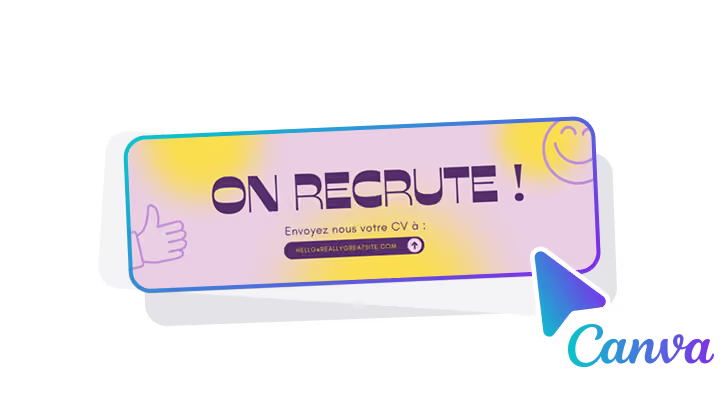
Carry out the campaign of the moment. This is where the signature banner comes into its own for Sales. An upcoming trade show, a customer case study to download, a trial offer: the banner turns each email into a marketing touch point with a clickable call to action. According to data observed on Signitic customers, the average click rate on a signature banner oscillates between 3 and 7% (source: Signitic, internal data 2024).
The challenge, for a Sales, is that the banner reflects the context of the prospect, not the generic corporate campaign of the moment. That is exactly what allows The Signitic x HubSpot integration : connect HubSpot contact lists and properties to signature campaigns to segment by persona, industry, or sales cycle stage. An AE that is prospecting health CIOs is pushing a health case customer banner. An AE that closes SMEs displays the ROI calculator. Each click on a banner connected to a HubSpot landing page goes back into the CRM, which turns the signature into a measurable pipeline source rather than just decoration.
What a Sales email signature should not do: overload with 10 lines of text, display an intimidating legal notice in body text, or use generic visuals that have nothing to do with the current sales cycle. The rule of a maximum of 4-6 lines of text also applies to salespeople: a signature that can be read on a mobile phone is a signature that works, regardless of the email client used by the prospect, whether it is on Outlook, Gmail or Apple Mail.
Marketing: the email signature as a measurable acquisition channel
The Marketing team sees the email signature differently than the other teams. Not as a medium, as a fully-fledged acquisition channel. Do the math: 100 employees who send an average of 30 emails per day, over 22 working days, that's 66,000 outgoing emails each month. To prospects, customers, partners, journalists, suppliers. This volume has already been paid for, already sent, already opened with an opening rate greater than 90% since these are expected 1-to-1 communications. Email signatures are the most under-exploited free advertising space in the marketing stack.
The role of Marketing, in this logic, resembles that of an internal traffic manager. He chooses which banner to push to which team, at what period, to which landing page. It measures clicks, conversions, and the pipeline generated. It iterates. The email signature joins LinkedIn Ads, Google Ads and email marketing in the acquisition mix, with the difference that it has an almost zero CAC.
The email signature of a Marketing employee must therefore:
Reflect the brand to pixel-perfect detail. Colors, typography, logo in the exact proportions of the charter. Marketing knows better than anyone what an offset pixel means for brand perception. His own signature serves as an internal reference for the other teams.
Deploy campaigns at scale, without IT. When a webinar is launched, when a product comes out, when a study is published, Marketing wants the banner to appear in the signature of Sales, Support, and Executives, in a few minutes. One centralized solution like Signitic allows you to push a banner across all employees in one click, without an IT ticket, without a reminder email for teams to update manually.
Tracker to measure attribution. Without UTM parameters, the email signature remains a blind channel. With well-established UTM, each click from a collaborator email arrives in GA4, HubSpot or Salesforce, with an identified source and an associated path. The subject is covered in depth in our article on UTM tracking in email signatures. To frame the global acquisition strategy through signing, the Signitic white paper “Email signatures: the levers of a winning strategy” poses the challenges lever by lever.
Respect good technical practices. For create a signature in HTML format, using web-safe fonts like Arial, Helvetica, or Verdana guarantees a consistent display on all devices and email clients, whether it's Outlook, Gmail, Apple Mail or Yahoo Mail. Avoid images that are too large or hosted locally, which can be blocked or end up in spam.
HR: the email signature as a showcase for the employer brand
Recruiters and HR teams communicate in contexts with a high emotional impact: invitations to interviews, feedback following applications, internal communications on organizational changes, job offers. The register is different from that of Sales or Marketing.
And there is a dimension that other teams do not have as explicitly: the HR email signature is an employer brand asset. Each candidate who goes through the process receives between 3 and 8 HR emails depending on the course. Each email is a point of contact that weighs on the perception of the company, as much as the Glassdoor sheet or the careers page. A careful HR signature, which highlights the culture, values or commitments of the employer, extends the brand promise without additional marketing budget.
What message the HR email signature should transmit?
Sobriety and professionalism above all. A candidate during the process needs to feel that they are interacting with a serious organization. In this respect, his email signature is a digital business card: it reflects both the culture of the company and the skills of the interlocutor.
Employer brand signals. Banner to the careers page, highlighting a recent award (Top Employer, Great Place to Work, Best Workplaces), Glassdoor or Welcome to the Jungle rating, employee testimonial, message on CSR commitments or remote work policies. An HR signature can carry in two centimeters in height what an entire career page costs to produce, and reach candidates who will never consult this page.
Transparency on the interlocutor. First name, last name, precise title (“Recruitment Manager” or “HR Business Partner”), telephone number, and if the corporate culture allows it, a professional image. In recruitment, the human dimension plays a real role. Candidates respond better to an email that clearly comes from an identifiable person than to a generic alias.
Relevant links for candidates. Company LinkedIn page, career space, link to the website if the recruitment page is neat. On the other hand, a promotional banner on a commercial offer has no place in an interview signature: this is the typical example of the bad signal sent due to a lack of segmentation.
In internal communication, the HR signature can carry different messages: a link to an engagement survey, an invitation to a training session, a reminder of an internal event. A tool like Signitic makes it possible to activate these banners only on internal emails, without them appearing in exchanges with external candidates, thanks to segmentation by recipients.
The question of brand image: a false problem
The first objection to email signature segmentation is often this: “If each department has its own signature, you lose brand consistency.”
It is a confusion between uniformity and coherence. Each signature must respect a common structure to guarantee graphic unity, without being identical for all.
A big brand does not advertise its B2B customers the same as its mainstream customers. However, its graphic charter remains recognizable everywhere. Email signature segmentation works on the same principle: a consistent email signature for all employees in a company reinforces brand recognition, but the contextual elements may vary between teams.
In practice, segmentation by department is organized around two levels:
The common base (not modifiable):
- Company logo with exact dimensions and colors
- Official “web-safe” font (Arial, Helvetica, Verdana)
- Main colors of the charter
- Links to corporate social networks
- Legal information if mandatory (see our article on email signatures and legal obligations)
Variable elements by department:
- Campaign banner (different depending on the business context)
- Additional links (link to the Sales calendar, HR career space, specific website depending on the offer)
- Profile image or photo (recommended for sales and HR, optional for other functions)
- Job title and title
This logic is at the heart of what we describe in our A complete guide to managing email signatures, which covers the global strategy whose segmentation is one of the central chapters.
Other functions: Finance, IT, Management
Sales, Marketing and HR are the most readable cases, but email signature segmentation applies to other contexts.
The Directorate-General communicates with investors, strategic partners, media. His email signature must reflect the highest level of representation of the company: exact title, no untimely commercial banner, link to the institutional page or the manager's LinkedIn profile.
The Finance and Accounting Team sends emails to suppliers, customers for reminders, banks. A simple register, with the necessary legal information, is more than enough. A webinar campaign banner in a bill reminder email creates a parasitic signal.
Customer support is a particular case: his messages are often sent from specialized messaging tools (HubSpot, Intercom, Zendesk), sometimes not from the main messaging system. When the email signature is present, it should reassure the customer about the care, with a link to the help portal. HubSpot, for example, allows you to personalize signatures in sequences of messages sent from the CRM, but consistency with the Outlook or Gmail signatures of the rest of the team is rarely guaranteed without a centralized tool.
How to create an email signature by department: practical guide
Creating an email signature segmented by team follows a four-step process. It's easier than it seems, especially if you use a dedicated signature generator.
Step 1: Define the common ground. Identify the non-negotiable elements of the graphic charter: logo, colors, font, official social networks. These are the elements that all signature templates share, regardless of department and sender profile.
Step 2: List specific needs by team. What links? What banner? Do we need an individual image? A direct phone number or a shared line? A service or nominative email address? These choices vary according to the practices of each team.
Step 3: create one signature per group with a signature generator. An online signature generator allows you to create templates in HTML format, customizable by department, compatible with all email clients (Outlook, Gmail, Apple Mail, Office 365, Yahoo Mail). Signitic centralizes the creation and deployment of models for all employees.
Step 4: Deploy and maintain. The advantage of a centralized signature generator: when the logo changes or when a campaign starts, the update is done at a glance, and is instantly reflected on all signatures. No more emails to employees to update manually.
To create a truly professional email signature, some technical advice is needed regardless of the team: limit the signature to 4-6 lines of text, use icons for links to social networks rather than plain URLs, check mobile compatibility before deployment, and ensure that images are hosted online rather than locally to avoid display problems.
Why it's hard to manage manually
Adapting email signatures by hand is an ongoing task.
The concrete problems that the teams encounter:
The cascading update. When the logo changes, when an employee changes position, when a campaign starts, each email signature must be updated individually. Without tools, IT is the one that inherits this task, or worse: each employee is contacted individually with random results.
Quality control impossible. Without a centralized signature generator, you don't know what the email signature of the new salesperson recruited last month really contains. Maybe he copied and pasted a colleague's. Maybe he put in his old email address.
The gap between groups. When Marketing launches a campaign and wants the signatures to reflect the webinar banner, without segmentation by group, it must contact all sales representatives hoping that they update manually. Effective update rate observed in this case: rarely above 60% after a week of reminders.
Centralized signature management, with segmentation by group or department, solves all three problems at once. This is exactly what our article on Email signature charter : lay the foundations of a system that runs without daily intervention.
What it changes in concrete terms: example of an ETI of 150 people
Let's take a concrete example: an ETI of 150 employees, with 40 salespeople, 4 people in Marketing, 5 in HR and the rest in support functions.
Before segmentation:
Marketing is launching a webinar campaign. He sends an email to all sales representatives to update their email signature. Result after one week: 60% update rate. A candidate receives an email from an HR recruiter with a banner “Commercial offer -20% this month”. A sales manager changes phone number. His signature was not updated for three months.
After segmentation with a centralized signature generator:
The webinar campaign is deployed in 10 minutes to the 40 sales representatives, without sending them any message. HR has a dedicated, sober model, without a commercial banner, which pushes the current employer award to candidates. The change in the contact details of the sales manager is instantly reflected in all his signatures, as soon as the directory is updated.
The testimony of Margaux Rousset, Marketing Project Manager at Groupe Nerco (220 employees), illustrates this case well: “The most useful aspect of Signitic in my daily professional life is the automation of the creation of signatures for newcomers. This allows for rapid and consistent deployment of signatures across the enterprise.”
Frequently asked questions about professional email signatures
How do you write a good email signature?
A good email signature includes essential information: name, first name, position, company name, telephone number, email address, and links to relevant social networks. All on 4-6 lines maximum. HTML is recommended to ensure display on all email clients (Outlook, Gmail, Apple Mail, Yahoo Mail, Office 365). Adding the company logo and adopting the colors of the graphic charter reinforces the brand image. For Sales and Marketing teams, a banner with a clickable call to action turns each email into a lead generation opportunity.
How do you sign your professional emails?
The professional signature must be adapted to the context of the communication. A salesperson signs with his direct contact details and a campaign banner. A recruiter adopts a simple register and highlights the career space. A manager signs with his exact title and institutional contact details. The use of a signature generator makes it possible to create models adapted to each profile, consistent with the graphic charter, and deployable on all company messaging systems.
What are the best practices for email signatures?
Limit the signature to 4-6 lines of text, use “web-safe” fonts (Arial, Helvetica, Verdana), check the rendering on mobile, integrate social media icons instead of plain text URLs, and host images online. For large teams (20 employees and more), a centralized signature generator is the most effective solution to ensure consistency and facilitate updates.
How do you manage email signatures across a company?
Managing email signatures at scale requires a centralized tool. Signitic, for example, makes it possible to create templates by department, to deploy signatures to all email systems (Outlook, Gmail, Google Workspace, Office 365) in one click, and to update campaign banners in real time. Each arrival or departure of an employee is managed automatically, without manual intervention.
Segmentation, the first step towards a comprehensive signature strategy
Segmentation by department is a brick, not a goal. It is part of a broader logic of managing email signatures, which also covers governance (who decides on the models?) , measurement (how to track clicks and leads generated by department?) , and marketing use (how do you coordinate banners with the campaign calendar?).
These questions are addressed in depth in our A complete guide to email signatures. If you're starting from scratch, the correct order is:
- Define the email signature charter (common base)
- Identify groups to be segmented (Sales, Marketing, HR, Management, others)
- Create templates by group with a signature generator
- Deploy centrally to Outlook, Gmail, and other email clients
- Measuring results and optimizing
Starting with segmentation without having laid down the charter means building rooms in a house without load-bearing walls.