




You have a sales team of ten, twenty, maybe fifty people. Each day, everyone sends an average of thirty to fifty emails. Do the math: several thousand brand communication opportunities leave every week, without any consistency, without any commercial message, often without even a properly displayed logo.
The email signature is probably the most underexploited marketing channel in your organization. Unlike a LinkedIn campaign or promotional emailing, it costs nothing in additional distribution. It is based on conversations that are already in progress, with interlocutors that are already engaged. And yet, most sales teams treat it as an administrative formality.
This article explores why email signature management tools have become strategic for sales teams, and how to use them to actually generate more opportunities.
Why the email signature is a commercial lever for sales teams
For a long time, email signatures were the job of the IT department. We would set up a template in Outlook or Gmail, hope everyone would apply it correctly, and move on. The result: an anarchy of formats, signatures that vary from one commercial to another, logos that are pixelated or absent.
This lack of rigor has a real cost. A prospect who receives an email from a salesperson whose signature is poorly constructed immediately receives a negative signal about the professionalism of the company. Conversely, a careful signature, consistent with the graphic charter and enriched with a relevant call to action reinforces credibility in each exchange.
But what really changed the situation was the ability to go far beyond a simple block of coordinates. Today, an email signature can include a clickable banner, an appointment button, a webinar invitation or a link to a case study. And all of this, managed centrally, for the entire team.
5 email signature use cases to boost sales
This is where email signature tools reveal their true value. Here are the most effective use cases for a sales team.
1. Banner campaigns for a product launch
Imagine your sales team in the middle of a prospecting cycle when your business launches a new feature or product. Each email sent can carry a visual banner announcing this launch, with a direct link to the dedicated page or a demonstration video.
This type of banner campaign, coordinated via a centralized tool, makes it possible to transform each salesperson into a promotional relay without having to do anything. The banner is automatically activated in all signatures, over a defined period of time. At the end of the launch, she disappears, without anyone needing to intervene on her computer.
The Significtic use case: We have launched a new free offer dedicated to organizations with less than 20 employees. During the three weeks of the launch, each outgoing email from the sales team displays a banner with a link to The landing page. Result: several hundred qualified clicks without additional advertising budget.

2. The “Book a demo” button
The appointment button is arguably the most profitable call to action for a sales team. Integrated directly into the signature, it allows any recipient (cold prospect, hot lead, contact under nurturing) to book a slot in one click.
The advantage is twofold. On the one hand, the salesperson no longer has to manage the back and forth trips to set up an appointment. On the other hand, the prospect can act exactly when he is mentally available, often a few minutes after reading the email, not two days later when the salesperson has relaunched.
Tools like Signitic make it possible to integrate this type of link dynamically, with customization by salesperson (everyone has their own Calendly, HubSpot Meetings or Google Calendar) while maintaining visual consistency for the entire team.
3. Promoting events and webinars
Sales teams are actively involved in lead generation for marketing events, but they rarely have the time to promote these events individually. The email signature solves this problem elegantly.
By integrating a “I participate” banner or insert directly into the signatures, all ongoing conversations automatically become a promotion channel. A salesperson talking to a prospect about a contract renewal may unwittingly encourage them to sign up for the next product webinar.
The Significtic use case: A few weeks ago we launched a new feature: Hubspot segment targeting. For the occasion, we organized a webinar entitled “Boost your CTR: Personalize your banners according to your HubSpot segments.” The sales team does not have to do anything, and the registrations from the signatures represent 15% of the total.

4. Highlighting social proof content
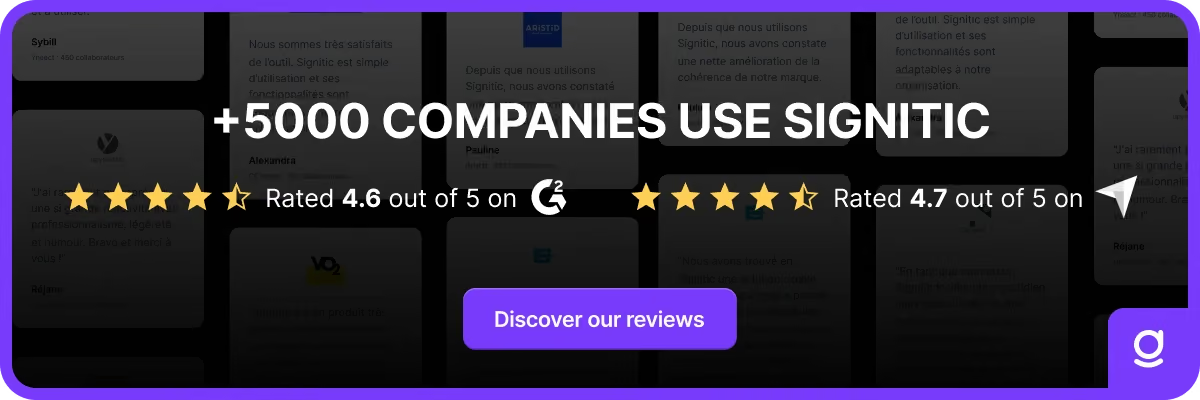
In the closing phase, social proof is decisive. Customer testimonials, case studies, notes on G2 or CapTERRA, sector certifications, anything that reinforces credibility can find its place in an email signature adapted to the context.
Some teams set up automatic banner rotations: one week highlights a customer testimonial from a specific sector, the next one points to an analyst report. Others personalize signatures by segment or vertical, so that the content displayed is always relevant to the interlocutor.
5. Prospecting signatures vs. closing signatures
A salesperson does not write the same way to a cold prospect as to a customer in the process of negotiation. Its tools should reflect this reality. Signature management platforms like Signitic make it possible to create different signature profiles depending on the context: a “prospecting” version with a discovery tone and a link to a useful resource, a “closing” version with a direct call to action towards the demo or the proposal.
What features to look for in an email signature tool for salespeople
Not all tools are created equal. Here are the criteria that really matter for a sales team.
Centralized management with local autonomy
Marketing must be able to control the framework: graphic charter, active banners, approved formats. But the salesperson must be able to personalize certain elements, his exact title, his hotline number, his appointment link. A good tool manages this frictionless cohabitation.
Deployment without IT dependency
In the reality of commercial organizations, salespeople use a wide variety of workstations, work from their mobile, send emails from the Gmail application on their phone or from Outlook. A tool that only works on a specific email client or which requires intervention by the IT department at each update is unusable in practice.
Cloud solutions like Signitic manage the signature on the server side or through lightweight extensions, ensuring that every email, regardless of the device or client used, displays the correct signature.
Targeting and segmentation of campaigns
The sales team is not monolithic. Sales Development Representatives have different needs than Account Executives, who differ from Customer Success Managers. A good tool allows you to segment banner campaigns by team, by office, by region or even by individual salesperson.
Analytics to measure impact
How many clicks on the “Book a demo” button this week? Which banner generates the most engagement? Which salesperson has the most successful signature? This data exists if the tool captures it. Without analytics, the signature remains a blind communication tool. With them, it becomes a measured, optimizable and justifiable lever for management.
How to integrate an email signature tool into your sales stack
The real value of email signature tools comes when they integrate with the rest of the sales stack. CRMs like HubSpot or Salesforce can automatically feed in some signature data. Sales engagement tools like Smartlead or Outreach benefit from consistent signatures even in automated sequences. Analytics tools make it possible to correlate clicks on signatures with open opportunities.
This integration transforms the signature of a static element into an active component of the business cycle. It contributes to the coherence of the prospect experience, reinforces credibility at each point of contact, and generates actionable data.
How to deploy an email signature for an entire sales team
The successful deployment of an email signature tool in a commercial organization generally follows a few simple steps.
- Audit of the existing system: identify the signatures currently used, identify the inconsistencies, list the desired use cases.
- Definition of the governance framework: who validates the models? Who can change what? Who manages banner campaigns?
- Creation of models: develop the templates in accordance with the graphic charter, by providing variants by team or by role.
- Setting up integrations: connect the tool to salespeople's calendars for appointment scheduling links, to CRM tools if necessary.
- Deployment and training: schedule a short onboarding session so that salespeople understand how to personalize their signature within the defined limits.
- Implementation of monitoring: activate analytics, define the KPIs to be monitored (clicks, engagement rate, conversions resulting from signatures).
The email signature, a commercial channel in its own right
The email signature is no longer a simple digital business card. For a well-organized sales team, it is a fully-fledged, coherent, measurable channel that can be activated according to the priorities of the moment.
Centralized management tools like Signitic make it possible to go from a completed signature to a strategic signature. Banner campaigns for product launches, CTAs for booking appointments, the promotion of events, the promotion of social proof: all concrete uses that generate value without burdening the work of salespeople.
In a context where every touchpoint with the prospect counts, it would be a shame to let thousands of emails go away every week without getting the most out of them. The email signature is perhaps your least exploited commercial lever, and one of the easiest to activate.
Want to see Signitic in action?
In 30 minutes, our teams show you how to centralize and activate the email signatures of all your salespeople: banners, appointment buttons, targeted campaigns by team.
👉 Book a demo with the Signitic team.