

An email signature banner is a clickable visual placed under each employee's contact details, used to promote an event, product, or resource. Signitic observes an average click rate between 3 and 7% on its customers' banners, compared with 2.5% for traditional email campaigns, with no distribution budget or list-building required.
Banners in the email signature: transform each email sent into an active campaign
Your teams send hundreds of emails per week. Commercial reminders, support responses, partner exchanges, appointment confirmations. Each email leaves with a signature at the bottom. And this signature contains, for the most part, exactly the same thing for months: a name, a title, a telephone number.
It is marketing potential that disappears with each sending.
The email signature banner is a clickable visual integrated into each employee's signature. Seen by people who have already opened the email and read its content, it benefits from an exposure rate that other marketing formats do not reach. The audience is already there, in every daily exchange. No broadcast budget, no list to build, no algorithm to convince.
Why the email signature banner outperforms most B2B marketing formats
An exposure rate that few channels can claim
According to the Socialinsider 2025 benchmarks, the average organic engagement rate on LinkedIn varies between 2 and 5% depending on the sector, with a reach that rarely exceeds 10% of a page's subscribers. On the classic email marketing side, Sarbacane on the opening rate in B2B places the average around 20 to 25% depending on the sector, with a good opening rate between 15 and 25%. An individual email sent in an active conversation, on the other hand, is opened in almost 100% of cases. And readers spend an average of eight seconds on an email, much more than on a display ad they saw in passing.
The signature banner takes advantage of this context. It appears in exchanges that your prospect or customer has chosen to open, often several times in the same day if the conversation is active. Repeated, contextual, non-intrusive visibility.
Signitic observes an average click rate between 3 and 7% on its customers' banners (Signitic internal data, 2024). Sectoral studies confirm this order of magnitude: email signatures have an average click rate of 4%, compared to 2.5% for traditional email campaigns. Integrating banners into email signatures can increase the click rate by 22% according to the examples documented by Signitic (source: Signitic resources).
What the banner does that the newsletter doesn't
A newsletter arrives at a time chosen by the sender. A signature banner appears when the prospect has decided to open the email, in a context where he is already available and attentive. It is not the same reading register.
The banner also benefits from a context of trust that the newsletter does not generate. When a salesperson you talked to last week sends you a reminder, you look at their signature. If it has an invitation to a relevant webinar, you will click, not because an email marketing targeted you, but because you were already in conversation.
62% of professionals who use email signatures in their communications confirm that they use them to give visibility to their business. 82% of marketers use them to increase brand awareness (source: Newoldstamp, “The State of Business Email Marketing”, “The State of Business Email Marketing”, report 2024, report 2024, survey of 750+ marketers and business owners). Our guide to managing email signatures expand this point: the signature is a distribution channel, not just a coordinate block.
The four use cases where signature banners generate the most results
Webinars and events: the contextual invitation that converts better than a dedicated email
A webinar is scheduled in three weeks. Each email sent by your teams during this period may include a discreet but visible invitation: date, subject, registration link. The prospect sees the invitation in the context of a conversation that has already begun, not in their stack of marketing emails.
Teams that activate this configuration see their registration rate increase without increasing the volume of communication. According to data documented by Signitic, signature banners generate +22% of clicks and +32% of responses on event campaigns (source: Signitic resources).
For professional salons, even mechanical ones. Activate a commercial signature banner a few weeks before the event. Prospects already in contact with your sales representatives receive the information naturally, with a link to make an appointment on site.
Product launches: the whole team as a coordinated relay in a few clicks
During a launch, coordination between teams is the crux of the problem. Marketing wants everyone to carry the same message. Sales, support, technical teams send dozens of emails a day without thinking of mentioning the novelty.
Activating a banner on all signatures at launch time solves this problem all at once. In a few clicks from the Signitic features, each email sent by each employee becomes a relay of the launch message, coordinated and visually coherent, without anyone having to modify their signature manually.
The Cognism case illustrates the scale of possible impact. The London-based B2B lead generation platform generated 143,000 impressions on the announcement of a new feature thanks to the email signatures of its collaborators, plus 41,421 impressions on the invitation to a customer-exclusive webinar and 14,000 impressions on the announcement of their Chrome Extension 2.0 (with a click rate of 0.89%). Above all, their conversion rate between webinar registration and business opportunity is 25%, and Signitic is now among their top three acquisition channels for webinar registrations. The method: two separate campaigns at the launch of their Dialer feature, one for the sales team in contact with prospects, one for customer service in contact with existing customers.
Resources and content: reach leads already in your sales pipeline
A white paper has just been released. A sector report is available. A case study has been published. These resources are of interest to prospects already in the sales cycle, which is exactly the people your salespeople are talking to right now.
Activating a banner on sales team signatures for two to three weeks around each post ensures that the resource reaches the right people at the right time, without additional email marketing. Directing traffic to your landing pages via email signatures can increase this traffic by 25% according to the examples documented by Signitic, turning each email sent into a qualified contact point.
Targeted internal communication: a use that most teams do not yet exploit
Signature banners aren't just for external communications. Activate them on internal emails to broadcast important announcements: job opening, team event, satisfaction survey, training reminder. The information arrives in the thread of each exchange, without creating an additional notification in the messages already loaded.
Signitic allows you to configure banners that are visible only on internal emails, distinct from those that appear in external emails. Many teams discover this feature late, and regret not having activated it sooner.
The Aristid case shows the power of this multi-audience logic at scale. French retail tech leader with 15,000 daily users in more than 10,000 stores, Aristid has divided its organization into 7 Signitic groups to adapt each campaign to the right audience, while maintaining a single signature model to maintain brand image consistency. Their most effective campaign focused on their personalized e-catalog, deployed to all employees, which maximized visibility and impact both internally and externally.
How to design an email signature banner That generates clicks
What is the recommended size for an email signature banner?
The recommended dimensions for an email signature banner are between 600 and 800 pixels wide, and between 90 and 300 pixels high. In practice, 600 pixels wide by 150 pixels high is the most versatile format: readable on all email clients, adapted to mobile (more than 50% of email openings are done on smartphones), and compact enough not to weigh down the signature.
The size of the image file should remain under 100-150 KB for instant loading. Beyond that, the text/image ratio of the email deteriorates and anti-spam filters can intervene, affecting deliverability in Gmail, Outlook and other email systems. Also add alternative text (Alt-text) to your banner for accessibility and display when images are blocked.
For animated GIFs: Outlook only shows the first frame. So design your first image so that it can be understood without the animation.
Message and visual hierarchy: eight seconds to convince
Readers spend an average of eight seconds on an email. A five- to eight-word catchphrase, an optional one-line subtitle, and a call-to-action that clearly states where the click leads.
The ideas that work best in B2B: the announcement with a date (“Webinar November 18/Register”), the promise of a white paper with a concrete benefit (“Reduce your onboarding times by 40%”), temporary promotions with a deadline (“Free trial until November 30”). Too generic formulas like “Discover our solution” do not trigger anything for someone who is not in the active research phase.
Consistency with the company's graphic charter and social networks
The banner is part of the signature, which is included in the email, issued in the name of your company. Charter colors, well-sized logo, official typography: a visually inconsistent banner undermines exactly what the signature is supposed to reinforce in terms of brand image.
Also include links to your social networks in the signature. Among the platforms most represented in email signatures, Instagram comes out on top with 69.3% of signatures containing a link to this network, followed by Facebook (62.1%) and LinkedIn (42.3%). Signitic allows you to add these clickable icons directly into the models, without technical skills.
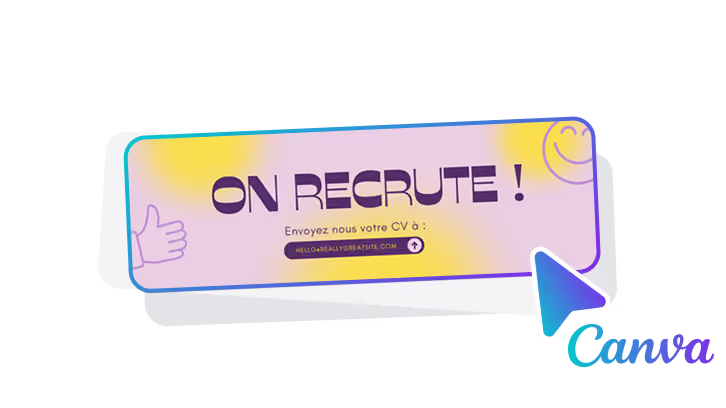
Native integration Signitic x Canva shortens the production chain: the teams create the visuals in Canva directly from the Campaigns module (“Create with Canva” button), then click on “Import into Signitic” to insert the banner without resizing or transferring a file. The time between the creation of a visual and its deployment on all the signatures of employees is counted in minutes.
Deploy a banner campaign without asking anyone to change their signature
Why manual management always fails
Without a centralized tool, deploying a banner on all signatures requires an email to employees with manual update instructions. The reality on the ground: a very partial update rate after a week of reminders. Different versions that coexist. Banners that remain active long after the end of the campaign because no one thought of removing them.
Alma de Clardian clearly states it in her testimony published on Signitic: “I am no longer running after anyone to harmonize the signature or to rotate banners.” This testimony summarizes the invisible cost of the absence of a dedicated tool.
Segment banners by department, team, or sending context
Enabling the same banner on all company signatures, all the time, is the wrong approach. A customer service email with a commercial promotion banner sends a poorly controlled communication signal. A recruitment email with a customer event banner, ditto.
A trade show is only for salespeople. A technical webinar is only for pre-sales and solution teams. An HR announcement should only appear in internal emails. Our article on signatures by department lays the foundations of this organization, the starting point before configuring the banners.
Program automatic deactivation at launch
A banner that is active after the end of the event it announces sends the opposite signal to that sought. Signitic allows you to program the automatic deactivation date at the time of configuration. The campaign ends, the banner disappears from all signatures simultaneously, without intervention. Many teams discover this feature after having experienced a webinar banner that was active three months after the event.
Measuring and optimizing an email signature banner campaign
Click rate per banner and analysis per collaborator
The click rate (CTR) is the main metric: clicks divided by emails containing the banner. A CTR between 3 and 5% is a good benchmark for a properly designed and targeted banner. Below 1%, the message or visual deserves revision.
Analysis by collaborator refines the diagnosis. A salesperson whose emails generate more clicks than his colleagues may be reaching out to a more qualified audience, or his messages are creating more context around the banner. This data guides coaching work as well as design work.
Linking clicks to conversions using UTM codes
A click on a banner is only valuable if it is attributable. The use UTM for email signatures allows you to precisely track the conversions generated by your email signatures and facilitates performance analysis via Google Analytics 4. Without these parameters, it is impossible to link the banner to a registration, a demo request, or a sale.
UTM setup takes five minutes per campaign. It conditions the ability to demonstrate the ROI of the channel, and therefore to obtain the resources to continue using it.
A/B test the variants to progress campaign after campaign
Testing two versions of a banner on the same campaign produces lessons that accumulate: the same message with a different visual, or even visual with a reformulated CTA. Signitic automatically distributes variants to different groups of senders and compares performance under real conditions.
The complete methodology of A/B testing applied to signatures is covered in our article on optimizing email banners through A/B testing.
Frequently asked questions about email signature banners
What is an email signature banner?
An email signature banner is a clickable visual integrated into the signature of a professional email, positioned under the contact information. It is used to promote an event, an offer, a white paper or a piece of content, by transforming each email sent into a marketing opportunity. It is not sent actively: it accompanies emails that would have been sent anyway.
What is the ideal size for an email signature banner?
The recommended dimensions are between 600 and 800 pixels wide, and between 90 and 300 pixels high. For optimal compatibility with Gmail, Outlook, and mobile email, 600x150 pixels is the most common format. The file size should remain under 100-150 KB to ensure instant loading and not affect deliverability.
How do I announce an event by email via signature?
Create a banner with the date, event name, and registration link. Activate it on the signatures of the teams concerned. Schedule automatic deactivation on the date of the event. All employees thus spread the invitation in their daily exchanges, without any manual action on their part.
What is a dynamic email signature?
A dynamic email signature is a signature that automatically adapts according to the context: different banner depending on the sender's department, the type of recipient (internal or external), or the current campaign. Content such as promotions, events or offers are updated in real time from a central interface, without the intervention of employees.
The three mistakes that cancel out the impact of signature banners
First mistake: the permanent and generic banner. A “Discover our solution” banner that has been active for six months has become invisible for all those who interact regularly with your teams. This format works when it's temporary and relevant, not when it sets up as an ignored background.
Second error: the inconsistency of context. A commercial offer banner in a customer service email, an invitation to a webinar in a billing email: these differences weaken both messages at the same time. Segmenting by sender and receiver types solves this problem at its root.
Third mistake: links without tracking. Without UTM parameters, you have clicks but no attribution data. The banner cannot be linked to a registration, a demo request, or a sale. And without demonstrable ROI, the channel remains an intuition rather than a lever.