
Quick Answer: Email signature marketing (ESM) is the practice of using the sign-off block at the bottom of business emails as an active marketing channel, by embedding branded banners, trackable calls to action, and UTM-tagged links that promote campaigns, drive demo bookings, and generate leads every time an employee sends a message.
Every B2B company already runs an owned media channel that reaches its ICP forty times a day, operates at near-zero marginal cost, and sits inside every email its team sends. Most of them don't track it. Most of them don't use it. A few have turned email signature marketing into a line on the revenue model that CMOs actually pay attention to.
That last group is small. It's also growing fast. US and UK demand gen teams that treat employee signatures as a serious acquisition surface now report attributable pipeline that rivals a paid social quarter, without the ad spend. Cognism, an international lead generation platform headquartered in London, generated over 143,000 signature impressions in the first month following a feature launch, with a 25% conversion rate from webinar registrations to sales opportunities, making signatures one of their top three registration channels (source: Signitic customer case study). None of that came from inflating the budget. It came from treating the signature as a channel, not a visual detail.
The economics make sense once you run the math. Email signatures sit on infrastructure the company already pays for, target inboxes the team already touches, and incur zero incremental media cost per impression. For demand gen leaders working against tighter budgets, that combination is rare.
This playbook is for the teams making that move. It skips the part where marketing has to argue that centralized signatures matter. It starts where the real revenue work begins: designing campaigns that convert, tracking clicks end-to-end across GA4, HubSpot, and Salesforce, running ABM plays through sales signatures, and building the business case for scale.
What is email signature marketing? A working definition for revenue teams
Email signature marketing refers to the practice of embedding marketing elements directly into the email signature block of every employee's business email. Instead of a static sign-off listing only a name, job title, phone number, and company logo, an email signature configured for marketing becomes a dynamic distribution surface.
Each email sent by anyone on the team, whether from a sales rep closing a deal, a support agent resolving a ticket, or an executive following up on a partnership, carries an active marketing message to a real inbox. The recipient doesn't opt in. The message lands because a real business email was exchanged. That's what makes email signature marketing structurally different from every other owned channel in the stack.
Email signature marketing vs. email marketing campaigns: not the same channel
These two disciplines are frequently confused, and the confusion leads to budget misattribution and missed opportunity. Email marketing campaigns go out through platforms like HubSpot or Positive User. They target opted-in lists, require CAN-SPAM or GDPR compliance flows, and typically reach contacts who've already engaged with the brand through a form or download.
Email signature marketing operates on completely different infrastructure. The email is sent one-to-one or one-to-few, through Google Workspace or Microsoft 365, by a human being who has a real relationship with the recipient. Email signature marketing reaches cold prospects, active customers, partners, and anyone in between, all in the same send, without any separate campaign setup in a marketing automation platform.
The two channels also differ at the attribution layer. Email marketing campaigns track opens and clicks at the list level. Email signature marketing tracks clicks at the landing page level using UTM parameters, which means every click lands in Google Analytics with a source, medium, and campaign tag, ready to be attributed to pipeline.
What makes up a complete email signature block
A complete professional email signature runs in three layers, each serving a different purpose.
The identity layer is the sign-off section that establishes credibility: employee name, job title, contact details, company name, and company logo. This layer changes rarely and applies uniformly across all employee signatures.
The brand layer enforces visual consistency across all signatures company-wide. This includes font size, color palette, and social media icons. A well-managed brand layer ensures every email looks like it came from the same company, even when sent by employees across different departments or geographies.
The campaign layer is where email signature marketing lives. This is the email signature banner or call-to-action link that rotates based on what's active in the marketing calendar. It points to a landing page with a UTM-tracked URL, and it changes with every new campaign the team runs. This layer is the revenue driver. The other two layers are its foundation.
Why so many email signature programs plateau (and how a few compound instead)
Adoption of branded email signatures is widespread. Execution quality is not. Most organizations using email signatures for marketing purposes are running one static banner, with no UTM tracking, no A/B testing, and no reporting line back to pipeline. They're getting some clicks, but they cannot tell you what those clicks produced in MQLs, opportunities, or closed revenue.
The teams generating real pipeline from this channel are a smaller group, typically demand gen teams with a disciplined UTM convention, a HubSpot or Salesforce integration that recognizes signature traffic as its own source, and a quarterly campaign calendar that rotates plays. That setup is what this playbook is designed to help you build.
For the foundational category definition, the comparison with email marketing campaigns, and the conditions under which the channel pays back the operational investment, see the complete definition of email signature marketing for B2B teams.
Why most B2B teams leave their biggest owned channel on the table
Email signatures are the most under-used owned surface in the B2B stack. A 30-person revenue team ships roughly 1.2 million external business emails a year. Each email is a branded touchpoint landing in the inbox of a prospect, customer, or partner. Most of those touchpoints end at a name, a title, and a phone number. No campaign. No link. No tracked click. Just a sign-off.
Treated as a channel, email signatures deliver something no other owned surface matches: guaranteed frequency at scale, with zero media cost, inside first-party inboxes the company already pays for.
The math: 25 reps, 40 emails per day, one million signature impressions per year
Run the numbers for a B2B company with 25 revenue-facing employees, a mix of SDRs, AEs, CSMs, and marketers. Each person sends around 40 business emails a day. That's 250,000 emails a month. Call it 3 million a year once you factor in replies, internal forwards that leak externally, and recipient CCs.
Three million touchpoints. If 5% of recipients look at the email signature, you've reached 150,000 email signature impressions per year. Benchmark click-through rates on well-designed email signature banners run between 0.6% and 2.5%. Even at the floor, you're looking at 900 to 4,000 tracked clicks a year from a channel that costs nothing extra to activate.
Teams who don't track this aren't missing a small thing. They're blind to one of the three largest owned distribution surfaces they operate, alongside the website and the marketing database.
Where email signature marketing fits in the modern B2B demand gen stack
Most demand gen stacks map to four owned surfaces: the website, the marketing database (email, SMS, push), paid media, and outbound sequences. Email signature marketing doesn't fit cleanly into any of those categories. It behaves like its own channel.
Signatures run on existing email infrastructure, but target external recipients. They carry campaign content like paid media, but compete for no budget. They reach the same audience as outbound sequences, without requiring sequencing software or SDR time. And they reach accounts the marketing database can't, because the message comes from a human, not a mass-send system.
The closest analog is retargeting, except the team controls the frequency, the message, and the cost. Revenue marketing leaders who adopt the discipline treat it as a fifth pillar of their owned mix, not a subset of brand work.
What revenue ops teams should realistically expect from this channel
Three outcomes are fair to expect from a mature email signature marketing program. A fourth is not.
Attributable clicks. Every email signature banner routes through a UTM-tagged link. Every click lands in GA4, then into HubSpot or Salesforce. You should be able to pull a report showing signature-sourced sessions, contacts, MQLs, and pipeline.
Influenced pipeline. Signatures rarely close deals on their own. They accelerate, nurture, and assist. Multi-touch attribution gives signatures credit when a prospect clicks a banner before converting on a demo form three weeks later.
Campaign-level ROI. With 8 to 12 email signature marketing campaigns a year, each tied to a business objective such as a launch, an event, or a content push, you can benchmark which plays move pipeline and which ones don't.
What's not fair to expect: signatures replacing a paid channel. They're additive, not substitutive. Teams who pitch them as a budget replacement tend to disappoint themselves within a quarter.
"The solution enables me to remotely manage e-mail marketing campaigns tailored to each of our subsidiaries. The daily 'clicks' report is an invaluable tool for monitoring our campaigns."
Mélanie, Groupe CEA
How to assess your current email signature program maturity in 15 minutes
Three questions reveal where a team stands. First, does every employee signature include an active campaign banner with a UTM-tagged link? If the answer is no or "some of them," the program is at ground zero. Second, does GA4 recognize utm_source=signature as a distinct channel, separate from "Other"? If not, tracking is broken. Third, can marketing pull a report in HubSpot or Salesforce showing signature-sourced contacts and pipeline for last quarter? If not, the channel is invisible to leadership.
Teams who can answer yes to all three are in the top 20% of email signature marketing programs. The remaining 80% have significant room to compound.
{{CTA-CONTENT}}
Email signature design that drives clicks, not just compliments
A professional email signature that generates consistent clicks doesn't happen by accident. Email signature design involves decisions about layout, imagery, visual hierarchy, and mobile rendering that directly determine whether recipients interact with the marketing elements or scroll past them. The way a signature looks is the first thing a recipient registers before reading the message above it.
Mobile-first email signature design: why more than 4 in 10 emails open on mobile
More than 41% of emails are opened on mobile devices, and only 16% in traditional desktop email clients (source: Litmus Email Client Market Share, 2025). Any email signature design that isn't built mobile-first is immediately giving up the largest single opening surface, plus the webmail audience that increasingly reads on phones and tablets too. Mobile-first means single-column layouts, tap-target CTA buttons of at least 44px, and email signature banner images that scale to a narrow viewport without losing their message.
The most common mistake in email signature design is building for desktop and assuming mobile will adapt. It doesn't. A multi-column layout that looks clean on a 27-inch monitor becomes a compressed, unreadable mess on an iPhone screen. The email signature banner, the piece that carries the campaign message, is usually the first casualty. Testing across email clients, including Gmail, Outlook, Apple Mail, and their mobile counterparts, should be part of every signature rollout.
Company logo, job title, and contact details: the non-negotiable signature elements
Three signature elements belong in every business email signature, regardless of role or department. The company logo establishes visual credibility and reinforces brand recognition across every email send. The employee's job title signals authority and sets context for the recipient. Contact details, specifically a direct phone number and relevant professional links, reduce friction for anyone who wants to follow up without replying by email.
These three elements also serve a compliance function in regulated industries, where legal disclaimers must appear in a smaller font at the bottom of the signature section. The identity layer of the email signature should be treated as permanent infrastructure. It changes only when someone's role changes or the company rebrands. Everything else, the campaign layer above it, is what rotates with the marketing calendar.
Social media icons and social media links: which platforms belong in a business email signature
Social media icons appear in most email signature templates by default, but the reflexive approach of adding every platform an employee uses is wrong. The social media links that belong in a B2B professional email signature are the ones the company actively maintains for business communication.
For most US and UK companies, that means LinkedIn, and depending on the industry, YouTube, Twitter/X, or a relevant community platform. Adding social media icons for every personal account an employee has, or including platforms the company doesn't manage, creates visual clutter and dilutes the email signature's click hierarchy. For most B2B use cases, LinkedIn is the one social media link that consistently earns its place in the email signature block.
The email signature banner: designing a CTA that converts
The email signature banner is the campaign layer of every professional email signature. It sits beneath the identity elements and carries the marketing message that changes with each new campaign. A banner that drives consistent click-through rates has four properties: a single, specific call to action; a visual that matches the company's brand palette; a destination URL with UTM parameters; and dimensions that render correctly across the email clients your recipients use.
Keep email signature banner dimensions between 600px and 700px wide for desktop renders. For the call to action, specificity beats generality. "Book a 15-minute revenue ops session" outperforms "Learn more." "Download the Q2 benchmark report" outperforms "Get the resource." For B2B audiences, "book a demo" works best when the destination is a direct scheduling page, not a homepage.
Email signature templates vs. custom HTML: what scales at 200+ employees
For companies with fewer than 50 employees, a well-designed email signature template managed through a centralized platform is usually sufficient. The template creates visual consistency across all employee signatures, enforces brand standards, and allows a marketing manager or signature manager to swap campaign banners without involving IT or asking every employee to update their own email client settings.
For companies with 200 or more employees, the template approach requires a signature management platform with role-based rules, department segmentation, and multi-entity support. Custom HTML email signatures introduce compatibility risks across email clients and become operationally unmanageable at scale without automation.
"Thanks to the segmentation proposed within the tool, we were able to manage signatures of each employee working in different territories. Campaign management is seamless, enabling us to promote different campaigns in different territories. Top-notch integration with Gmail & SFDC."
Florian, DIDOMI
Font size, color, and visual hierarchy in a professional email signature
Font size in email signatures follows a clear hierarchy. The employee's name typically renders at 14 to 16px. Contact details and job title sit at 11 to 12px. Legal disclaimers at the bottom drop to 9 to 10px. Text smaller than 9px becomes unreadable on mobile devices.
Color should follow the company's existing brand guidelines. Using a different palette in the email signature creates visual dissonance for recipients who've encountered the company's website or marketing materials. Consistency between email signature design and other brand touchpoints is a signal of operational maturity that recipients notice, even if they can't articulate it.
How to add images and social proof to a signature without cluttering it
Add images to email signatures only when they serve a purpose in the click hierarchy. The company logo belongs in every email signature. A banner image belongs when there's an active campaign. A headshot is optional and works better for client-facing roles than for technical or internal ones.
Social proof can strengthen an email signature when used sparingly. A single line citing a G2 ranking, a recent award, or a relevant customer result reinforces credibility without adding visual weight. Adding more than one social proof element in a signature section typically produces diminishing returns, because the email recipient's attention splits across competing signals rather than focusing on the call to action.
The 4 email signature marketing campaigns your team should be running
Most teams start with a single play, usually "promote the upcoming webinar," and stop there. The actual repertoire is wider. Four plays cover 90% of the revenue use cases in B2B email signature marketing. Each has a different cadence, a different success metric, and a different primary audience.
For 12 concrete email signature marketing examples organized by play type, with CTR benchmarks and CTA patterns for each, see the B2B email signature marketing examples gallery.
Play 1: product launch and feature promotion (the velocity play, 2 to 4 weeks)
When a SaaS company ships a meaningful release, the launch window is the highest-intent moment of the quarter. Email signature marketing campaigns are built for it.
Run time: 2 to 4 weeks, starting the day of launch and tapering as other channels pick up the distribution load. Audience: all outbound-facing employees, including sales, CS, marketing, and leadership. Call to action: a launch page with product detail, a short demo video, or a trial signup. Success metric: click-through rate on the email signature banner, plus demo requests attributed to utm_source=signature.
A practical example: when a B2B analytics vendor shipped a new attribution module, a 40-person team drove 1,800 clicks to the launch page across three weeks, entirely through email signatures. That traffic converted at 6% into trial starts, beating the organic conversion rate for that same landing page by 40%. Email signature traffic qualified well because the recipients already knew the brand.
Play 2: webinar, event, and demo amplification
The second email signature marketing play is the most common, and also the easiest to run badly. Teams promote an upcoming webinar the week of the event, get a spike of clicks, then pull the banner down the day after. The advanced version runs 3 to 4 weeks earlier, during the registration push, and swaps the banner post-event to a replay link.
One SaaS team running a virtual user conference promoted it through email signatures starting four weeks before the date. They rotated three variants: "save the date" for weeks one and two, "agenda is live" for weeks two and three, and "last chance to register" in the final week. They drove 34% of total registrations through email signatures alone. The incremental media cost was zero.
Play 3: ABM and account-specific plays with conditional email signature banners
This is where email signature marketing campaigns start looking less like brand work and more like precision demand gen. Enterprise-grade email signature platforms let teams deliver a different banner based on who the email recipient is, the sender's role, the recipient's domain, or account list membership.
Concretely: if an AE sends an email to a target account on a Tier 1 ABM list, their email signature shows a banner pointing to a tailored landing page for that account. If the same AE emails a prospect outside the list, the default company-wide campaign runs instead. The email recipient sees what feels like a personal touch. In practice, it's automated at the signature level, which is what makes it scale. This play requires clean account lists maintained in HubSpot or Salesforce, conditional display rules on the email signature platform, and alignment between marketing and sales on the message each tier receives.
Play 4: content and gated asset distribution (the nurture-by-stealth play)
The last email signature marketing play is the slowest-burning and often the most underrated. A team ships a new benchmark report, a playbook, or a customer case study. Instead of relying on paid search and organic traffic to distribute it, the email signature carries a persistent "get the report" banner for 4 to 8 weeks.
Every email the team sends pushes the asset to a real inbox. A link to a recent blog post works on the same principle for lower-barrier distribution. Over a quarter, this can drive 500 to 2,000 downloads on a single piece of content for a mid-sized B2B team. Those downloads feed the marketing database with prospects who've self-declared intent on a specific topic, already warmed up because the link came from a trusted sender, not a paid ad.
Bonus play: job offers and HR recruiting campaigns via employee signatures
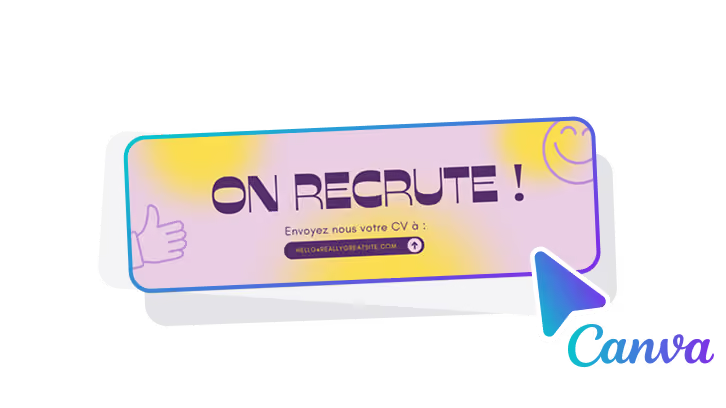
A fifth play that scales in periods of active hiring: using email signature banners to promote open positions. Every employee sending external emails becomes a passive recruiter. The email signature banner links to the careers page or a specific job offer, with an invitation to apply or refer.
For a company hiring across multiple roles, segmented banners by department work well: the engineering team's email signature promotes technical roles, the sales team promotes commercial positions, and the customer support team can highlight open service roles. The email recipient has already seen the company in action through real business email communication, which makes them a more qualified candidate or referrer than someone who found a job board listing cold.
Attribution that actually works: connecting signature clicks to pipeline across GA4, HubSpot, and Salesforce
This is where most teams either commit to email signature marketing as a real channel or quietly let it die. Attribution isn't optional for revenue marketing. An email signature marketing campaign that can't be traced to pipeline is a brand exercise, not a revenue play.
For the HubSpot-specific attribution setup including Sources mapping, Campaign Influence, and lifecycle stage workflows, see the step-by-step HubSpot signature tracking guide.
Four building blocks get the job done: a disciplined UTM convention, a Google Analytics setup that recognizes signatures as a distinct source, a clean handoff into HubSpot, and a reliable bridge to Salesforce for larger teams.
The UTM convention that survives an audit
Every email signature banner routes through a UTM-tagged link. No exceptions. The UTM convention that holds up at scale:
utm_source=signatureutm_medium=emailutm_campaign=[launch-name-YYYYMM]utm_content=[banner-variant-A-or-B]utm_term=[optional: ABM tier or department segment]
The value of this discipline is compound. Six months in, you can pull every signature-sourced session, group by campaign, compare banner variants, and answer "which three email signature marketing campaigns drove the most pipeline last quarter" in under ten minutes.
Common mistakes: using utm_medium=signature (breaks GA4 default channel grouping), letting individual reps edit their own UTMs (introduces typos that fragment reporting), or using free-form campaign names (makes quarterly reporting a manual cleanup job).
Google Analytics setup for email signature marketing campaigns: a step-by-step guide
In GA4, signature traffic needs to be recognized as a distinct channel before it can be reported cleanly. By default, utm_source=signature ends up in "Unassigned" or "Other," making email signature impressions invisible in channel-level reporting.
The fix, in three steps. First, in GA4, go to Admin > Data Settings > Channel Groups. Create a new custom channel rule: Session Source = "signature" AND Session Medium = "email." Name the channel "Email Signature." Second, verify the rule fires correctly by checking the Traffic Acquisition report the day after a new email signature marketing campaign launches. The "Email Signature" channel should appear with session data. Third, build a custom Exploration report tracking Email Signature sessions, engaged sessions, conversions, and goal completions for the past quarter. This becomes the reporting artifact for pipeline reviews.
Passing email signature clicks into HubSpot as a tracked source
For B2B teams running HubSpot, the integration pattern is straightforward. A prospect clicks an email signature banner, lands on a UTM-tagged page, and if they fill out a form or get cookied by the HubSpot tracking script, HubSpot logs the source automatically.
Three configuration points matter. First, confirm the HubSpot tracking code fires on the landing page the banner points to. Second, add signature as a recognized source in HubSpot's Traffic Analytics settings so it appears as its own channel group, not under "Other." Third, set up a workflow that tags any contact whose first touch or most recent conversion carries utm_source=signature with a "Signature-sourced" property.
At that point, you can build a HubSpot dashboard showing signature-sourced sessions, contacts created, MQLs, and deals influenced, all tied to a specific email signature marketing campaign. That dashboard is what marketing brings to revenue reviews.
Linking email signature marketing data to Salesforce opportunities
For teams running Salesforce, email signature clicks flow through UTMs into GA4 or HubSpot first, then the opportunity is created or updated in Salesforce, where marketing source fields need to be populated. The standard setup uses Campaign Influence (native Salesforce) or a marketing attribution layer like Marketo, Dreamdata, or Ruler Analytics. The email signature marketing campaign becomes a Salesforce Campaign, and leads who convert via a signature click get added to it.
Common operational trap: the signature campaign gets created in the email signature platform but never mirrored in Salesforce as a proper Campaign record. Without the Salesforce Campaign, opportunity reporting can't credit email signatures. The fix is operational, not technical: add "create the matching Salesforce Campaign" to the launch checklist for every email signature marketing play.
The "influenced pipeline" metric: how to count it without double-counting outbound
Influenced pipeline is the most honest way to value email signature marketing, and the easiest to misreport. A clean definition: "pipeline influenced by email signatures" equals total ARR of opportunities where at least one buying-group contact had a signature-sourced touch in the 180 days before the opportunity creation date.
Two guardrails keep this metric clean. First, exclude signature clicks from existing customers on renewal cycles, they're not net-new pipeline. Second, don't stack signature-influenced pipeline on top of outbound-influenced pipeline without a deduplication layer. Most teams who report signature-influenced pipeline after 6 months of disciplined tracking land between 8% and 22% of total pipeline. Teams running ABM plays at scale hit the upper end.
ABM at scale via employee email signatures: the play nobody else is doing well
Account-based marketing and email signature marketing are a natural fit that almost nobody exploits properly. ABM concentrates effort on a named list of accounts. Email signatures deliver targeted campaign content on every business email the team sends. Combine the two and you've built a precision channel that operates at the cost of your existing email volume.
For the full ABM email signatures playbook including tiering frameworks, conditional display rules, and account-level attribution setup, see the complete ABM signature playbook.
Tiering your target account list and matching signature content per tier
Start with the ABM tiering your Revenue Ops team already maintains. Tier 1 contains the top 50 to 100 named accounts receiving full bespoke treatment. Tier 2 covers the next 200 to 500 accounts on a 1-to-few programmatic play. Tier 3 is the remaining named account universe receiving the default company-wide email signature marketing campaign.
Each tier gets a matched signature strategy. Tier 1 accounts see banners pointing to tailored landing pages, sometimes personalized to the account's industry. Tier 2 accounts see vertical-specific banners. Tier 3 accounts see the current company-wide campaign. This approach doesn't create new account lists. It operationalizes the ones Revenue Ops already maintains.
Using sales and CS email signatures as a covert ABM channel
The power move in ABM signature marketing is conditional display. Enterprise-grade email signature platforms let marketing display a different email signature banner based on rules: the sender's department, the email recipient's domain, account list membership, or geographic region.
For ABM, the rule that matters is recipient domain. When an AE sends a business email to @targetaccount.com, their email signature swaps to the banner for that account's play. When they email anyone else, the default campaign runs. The email recipient sees what feels like a personal touch. After setup, it costs zero incremental effort from sales or CS.
What Sigstr and Terminus proved (and what their acquisition taught the market)
Email signature marketing as a distinct US category was legitimized between 2014 and 2018 by Sigstr, an Indianapolis-based startup that built email signature marketing campaigns into a standalone platform. Sigstr was acquired by Terminus in December 2019 specifically to strengthen Terminus's ABM capabilities with signature technology. The acquisition thesis was explicit: email signatures are a high-value ABM delivery channel, not a brand accessory.
The decade that followed saw Terminus consolidate ABM tooling, and the signature-specific product lost standalone visibility. That history matters for two reasons. It confirms the category isn't speculative, a well-funded ABM platform paid to own it. And it exposes the current market gap: there's no longer a dedicated US-native pure-play for email signature marketing. Teams who want signature-first tooling built for revenue marketing have to look elsewhere.
Coordinating email signature campaigns with LinkedIn ABM and SDR sequences
The highest-performing ABM programs run email signature marketing campaigns in concert with LinkedIn and SDR outreach, not in isolation. A typical coordinated play for a Tier 1 account: the SDR sends a personalized outreach email (their email signature shows the bespoke ABM banner for that account), LinkedIn runs a matched audience ad to the same buying group, and the AE follows up with a second email carrying the same signature campaign.
The buying group sees the account-specific message across three surfaces in the same week. In a published Demandbase customer case, healthcare platform League boosted meeting booking rates by 41% on target accounts that received coordinated multichannel treatment compared to those that didn't (source: Demandbase / League case study). The email signature campaign builds the frequency the other channels can't sustain at that cost.
A/B testing, click-through rate benchmarks, and email signature marketing examples that convert
Revenue marketers who run paid channels don't accept "let's launch and see what happens." The same discipline applies to email signature marketing campaigns. Testing is cheap, fast, and produces data that compounds across every future campaign.
For the complete A/B testing methodology with UTM convention, GA4 channel setup, and Campaign Scheduler workflow, see the email signature A/B testing methodology guide.
What to test first in your email signature marketing campaigns
The testing hierarchy for email signature banners, from highest leverage to lowest:
- Call to action wording. "Book a demo" vs. "See the 3-minute tour" vs. "Download the new report." The CTA wording carries 40 to 60% of the click-through lift in most tests. Start here before changing anything else.
- The offer itself. A free audit outperforms a demo request in early-funnel email signature marketing campaigns. A product tour beats both for consideration-stage audiences.
- Visual design. Brand-heavy email signature banner designs vs. product-screenshot visuals vs. text-only formats. Test visuals only after CTA wording and offer are confirmed.
- Placement and size. A single large banner under the signature block vs. two smaller banners vs. a banner with a supplementary text link. Smallest incremental gains at this level.
Run one test at a time. Set a minimum sample of 5,000 sends per variant before calling a winner. Most email signature A/B tests reach statistical significance within 10 to 14 days for a team of 25 or more employees.
Email signature marketing examples with the highest measured click-through rates
The email signature marketing examples that generate the most clicks share a common structure: a visually clean banner, one specific offer, one clear call to action, and a destination landing page that delivers on the banner's promise without adding friction.
A customer support team promoting a new help center outperforms on click-through rates when the email signature banner links directly to a relevant article, not to the homepage. An SDR running a campaign around an upcoming webinar generates more registrations when the banner shows the event date prominently with a direct booking link. Email signature marketing examples that work best in ABM contexts typically use the account's industry or persona type in the banner headline.
You can see a full breakdown of email signature marketing examples by campaign type and measured CTR in our campaign library, organized by play type.
CTR benchmarks by campaign type for B2B email signatures
Performance varies significantly by play type. Based on aggregated email signature marketing campaign data across B2B SaaS teams:
- Product launch banners: 1.2% to 2.8% CTR. Highest because recipients know the brand and launches create urgency.
- Webinar and event promotion: 0.9% to 2.1% CTR. Varies with event quality and audience fit.
- ABM account-specific banners: 2.5% to 5.0% CTR. Highest of all, because the content is explicitly relevant to the email recipient's company.
- Content and asset distribution: 0.6% to 1.5% CTR. Lower peak, but persistent volume across weeks accumulates.
A team running 6 to 8 email signature marketing campaigns a year across mixed play types typically lands between 0.8% and 1.6% blended CTR. Cognism drove over 143,000 signature impressions in the first month of a feature launch and a 25% conversion rate from webinar registrations to opportunities on follow-up campaigns, making signatures one of their top three registration channels (source: Signitic customer case study). You can benchmark your email signature CTR against B2B averages to see where your program stands.
What above-average signature impressions actually deliver in influenced pipeline
Email signature impressions and click-through rates are input metrics. The output metric is pipeline. A healthy benchmark for a mid-market B2B SaaS team: one in 30 to one in 60 email signature clicks converts into an MQL. Of those MQLs, 15 to 25% progress to a sales-accepted opportunity. A team generating 2,000 signature clicks per quarter can expect roughly 33 to 66 MQLs and 5 to 16 opportunities.
At an average B2B deal size of $40,000 to $80,000, that translates to $200,000 to $1.3 million of influenced pipeline per quarter from email signature marketing. The range is wide because it depends heavily on ABM activation, deal velocity, and attribution model maturity.
The diagnostic question to ask at every quarterly business review
Revenue channels operate in two modes: compounding and flat. The question to ask at every QBR: "Is our email signature program generating more pipeline this quarter than last? If not, why?"
Three compounding levers matter most. First, headcount growth: more employees means more email signature impressions automatically. Second, campaign cadence: running 8 email signature marketing campaigns a year rather than 4 roughly doubles click volume at the same team size. Third, ABM activation: moving from blanket campaigns to tier-matched signature plays typically lifts CTR by 2x. If the program has been flat for two consecutive quarters, the issue is almost always campaign cadence, not creative quality.
Scaling email signature marketing from 25 employees to 500+: the revenue ops playbook
Operational complexity in this channel scales non-linearly. At 25 employees, a marketing manager can update employee signatures manually and run email signature marketing campaigns on instinct. At 500 employees, the same ad-hoc approach produces chaos, missed updates, and brand risk. Four disciplines get teams from startup-scale to mid-enterprise without the operational mess.
Governance: who owns email signature marketing (marketing, not IT, not individual employees)
The single most important decision for scaling: the channel belongs to marketing. Specifically to demand gen or revenue marketing, not to IT, not to individual employees, and not to HR.
IT left to manage email signature design will ship one static professional email signature per role and never touch it again. Individual employees managing their own signatures will break the brand within a week and ignore UTM parameters entirely. HR cares about legal compliance in the signature section, not click-through rates.
"Signitic is a digital marketing tool that is becoming key for our activity as a SaaS software publisher. When a signature is not entirely up to date with our news, the sales team complains, which is an excellent signal."
Maÿlis Staub, Data Legal Drive
A clean ownership model: marketing sets campaign strategy and brand standards, IT handles technical integration, and sales or CS provides input on messaging for their specific audiences. A single marketing manager or signature manager owns the calendar, ships creative, reviews performance weekly, and reports pipeline influence monthly. You can see how this governance model plays out in practice in our email signature governance framework for B2B Revenue Ops teams.
Campaign calendar rhythm: how many email signature marketing campaigns per quarter
Mature B2B programs run 8 to 12 email signature marketing campaigns per year, with 2 to 4 active in parallel: one main company-wide play, plus one or two ABM-targeted plays for specific account segments.
A practical quarterly rhythm:
- Week 1: Launch the new company-wide email signature marketing campaign.
- Weeks 2 to 5: Main campaign runs with A/B tests actively in market.
- Weeks 3 to 8: ABM plays layered on top, targeting 1 to 3 specific account segments with differentiated banners.
- Week 12: Retrospective and pipeline review, benchmarked against the previous quarter.
Teams running fewer than 4 email signature marketing campaigns per year rarely reach compounding performance. Teams running more than 14 tend to exhaust their audience and see declining click-through rates as recipients habituate to the banner format.
Integration with paid media, content, outbound, and events
Email signature marketing campaigns work best when coordinated with other channels, not managed as a standalone silo. The model to replicate: treat every major campaign as multi-channel, with email signature marketing as one of the distribution legs alongside paid, organic, email nurture, and outbound sequences.
Example for a new product launch: paid social drives brand awareness campaigns to cold audiences, a recent blog post publishes on launch day, outbound sequences reach target accounts, email nurture drops to the installed base, and employee signatures carry the launch banner across every external business email. Email signature marketing provides the always-on frequency layer that keeps the launch visible in every inbox the company already touches. When coordinated this way, signature data often surfaces buying intent signals the other channels miss.
Building the business case: pipeline influenced, CAC reduction, and deal velocity
Three metrics translate email signature marketing performance into the language CFOs and CROs understand at a QBR.
Pipeline influenced: total ARR of opportunities with an email signature touch in the 180-day lookback. Target after two full quarters of disciplined tracking: 10 to 20% of total pipeline.
CAC reduction contribution: because email signature marketing costs nothing incremental beyond the platform license, every dollar of signature-influenced pipeline improves blended customer acquisition cost.
Deal velocity: opportunities with a signature touch in their history tend to close faster than those without. Typical lift reported by B2B SaaS teams: 15 to 25% faster close.
A program that can articulate its pipeline contribution, CAC impact, and velocity lift becomes a protected line item in the Revenue Ops model. One that can't loses its budget in the first finance-driven round of cuts.
For the complete ROI business case with CAC payback period calculations, ROI math by team size from 25 to 500 employees, and the QBR-ready framework, see the email signature marketing ROI business case.
FAQ: email signature marketing, etiquette, and best practices
What is email signature marketing?
Email signature marketing is the practice of using the sign-off section of every business email as an active marketing channel. A standard professional email signature includes an employee's name, job title, contact details, and company logo. An email signature optimized for marketing also includes a banner or call to action that promotes a campaign, a gated asset, a recent blog post, an upcoming webinar, or a product launch, linked to a landing page with UTM tracking. Email signature marketing requires no additional email sends, no opt-in database, and no media budget. It operates at near-zero marginal cost on the email infrastructure the company already pays for, making it one of the highest-ROI marketing channels available in the B2B stack.
What is the 80/20 rule in email marketing?
The 80/20 rule in email marketing holds that 80% of results, including opens, clicks, and revenue, come from 20% of campaigns or contacts. For email signature marketing specifically, the 80/20 rule translates to campaign concentration: most teams find that a small number of plays, typically ABM-targeted banners and product launch campaigns, generate the large majority of email signature impressions that convert into measurable pipeline. Identifying those high-performing plays early and running them more frequently is how email signature marketing programs compound rather than plateau. The implication is not to scale the number of campaigns indiscriminately, but to scale the cadence of proven plays while testing new ones at lower investment.
What are the 5 C's of email etiquette?
The 5 C's of email etiquette are Clarity, Conciseness, Coherence, Courtesy, and Correctness. In the context of email signature design and email signature marketing, a sixth implicit C applies: Consistency. A professional email signature that's consistent across all employee signatures, same company logo, same font size, same social media icons, same color palette, and same signature elements, reinforces all five C's every time a business email is sent. Inconsistent employee signatures, where one person has a handwritten signature image, another has a bare-text sign-off, and a third has a five-line promotional paragraph, undermine the brand's perceived credibility before the recipient has finished reading the message. Centralized email signature management is the operational mechanism that enforces consistency at scale.
What is the 60/40 rule in email?
The 60/40 rule in email refers to the recommended balance between text and images in marketing emails: roughly 60% text content, 40% image content. The reason is deliverability. Email clients are more likely to flag image-heavy messages as spam. For email signature design specifically, the 60/40 rule reinforces the case for keeping the email signature banner contained and the text elements dominant within the signature block. A signature that's mostly one large image with no readable text risks being blocked by image-suppressing email clients, meaning the marketing message never reaches the email recipient. Designing email signature banners with descriptive alt-text and at least one text-based link protects deliverability while preserving the marketing impact.
The compounding channel most B2B teams still underestimate
Email signature marketing is one of the few owned channels in B2B that still has room to run. It's underpriced (most teams operate it with a single marketing manager and a modest platform license), under-measured (the attribution models are more mature than most Revenue Ops teams realize), and under-activated (fewer than 20% of mid-market B2B teams run more than 4 email signature marketing campaigns a year).
For demand gen leaders building the 2026 playbook, the question isn't whether to include email signatures in the marketing strategy. It's how aggressively to scale them. The teams doing it well are already generating pipeline-influenced revenue in the $1 million-plus per quarter range from a channel that costs less than a mid-tier SEO tool.
The mechanics are straightforward: pick the four plays, enforce the UTM discipline, connect attribution into HubSpot or Salesforce, layer ABM on top once the basics are running, and report pipeline influence quarterly. None of it is technically difficult. All of it compounds once the campaign rhythm is in place.
Customer feedback consistently echoes this point. "Simple, effective, and easy to deploy" is the verbatim recurring across Signitic's user base, alongside specifics like "a real gain in time" and "we homogenized our entire signature stack quickly." That kind of operational simplicity, paired with measurable click-through performance, is what turns email signature marketing from a brand chore into a Revenue Ops line item.
Ready to turn every employee email into a tracked pipeline channel? Book a demo with Signitic to see how revenue teams centralize signatures, launch campaigns in minutes, and report signature-influenced pipeline back to the CRO.